
Private Credit: A Complete Guide for Modern Income-Focused Investors
A decade ago, a company needing $90 million called its bank. Now it calls an asset manager. Private credit has grown into a $1.7 trillion market. Here's how these loans actually work, who borrows, what you earn, and where the risks sit before you commit capital.


Ten years ago, a mid-sized company that needed $90 million to fund an acquisition called its bank. Today it's just as likely to call an asset manager.
That swap happened quietly, over about a decade, and it now represents a market somewhere between $1.5 and $2 trillion — the range is that wide because nobody agrees on what counts. It's what people mean when they say private credit. If you've been building income exposure out of bonds and bond funds alone, this is the part of the lending market you've been missing — and in 2026, with rates still elevated, it's worth understanding properly before you decide whether it belongs anywhere near your portfolio.
- Private credit grew out of the 2008 crisis. What was once a small corner of private markets was estimated at $1.5 to $2 trillion in assets at the end of 2024, with non bank lenders writing the direct loans that banks used to own outright.
- The bulk of the market is senior secured direct lending to middle market companies. These private credit loans usually carry floating rates tied to benchmarks like the secured overnight financing rate, which is where the yield premium over traditional fixed income comes from.
- Individuals can get in through interval funds, business development companies BDCs, and listed vehicles. The trade-offs are real, though: illiquidity, complex structures, and less transparency than you get in public markets.
- The honest summary is a trade. You're accepting liquidity risk, credit risk, valuation opacity, and a shifting regulatory picture in exchange for higher floating-rate income and some diversification.
- Manager selection is critical due to performance variability among private credit funds. Two private credit firms running what looks like the same strategy can land in very different places after a credit cycle.
What Is Private Credit?
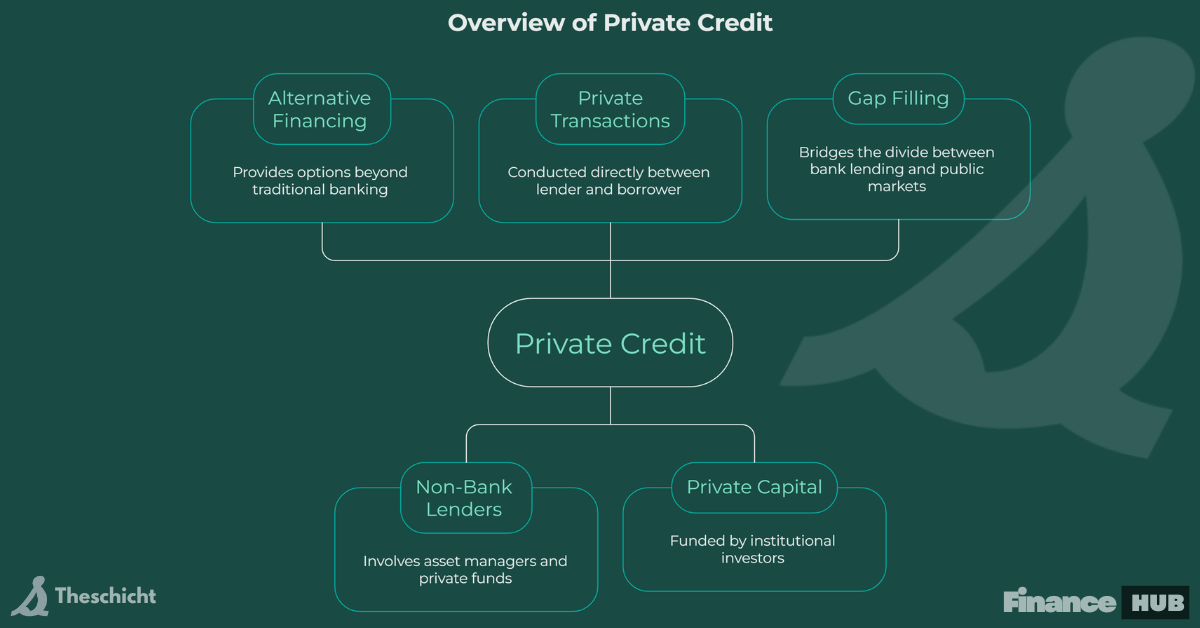
Private credit is lending negotiated directly between a non bank lender — an asset manager, a private fund, a business development company — and a borrower, without going anywhere near the public bond or syndicated loan market. It's private debt, funded by private capital and institutional investors rather than by a commercial bank's balance sheet.
The asset class sits somewhere between alternatives and fixed income, and it gets confused with private equity constantly. The difference is simple: private equity buys ownership, private credit lenders hold a creditor claim. They want to be repaid, not to own the business. And unlike public bonds, these private loans aren't traded around. They're written, monitored, and held to maturity.
Who borrows? Mostly middle market and upper-middle-market private companies, generally with EBITDA somewhere in the $25 million to $250 million range. Private credit investments generally attract middle-market or distressed companies — businesses too big for small-business lending, too small to tap large-cap syndicated markets efficiently.
The growth story starts in 2008. After the crisis, Basel III and related rules made leveraged lending expensive for banks, and banks pulled back. Private lenders walked into the gap. Then came a decade of low rates, and investors hunting yield poured capital in.
The numbers are striking. The Financial Stability Board put the private credit market at $1.5 to $2 trillion in assets at the end of 2024, and noted how concentrated it is in a handful of jurisdictions. The Federal Reserve estimated U.S. private credit at about $1.34 trillion in 2024. Part of the reason the range is that wide is that nobody agrees on what counts — different definitions of private credit produce very different totals, which the FSB flagged as a monitoring problem in its own right.
How Private Credit Works in Practice
Every private credit loan moves through five stages: origination, underwriting, structuring, monitoring, and exit.
Origination is relationship work. Private credit managers source deals through proprietary networks — private equity sponsors they've financed before, investment banks, management teams. A lot of these deals never see an auction. They arrive through a sponsor referral, or as a transaction a bank passed on because it didn't fit traditional bank lending requirements.
Underwriting is where the real diligence happens: cash flow modeling, downside stress tests, collateral valuation, an honest read on management, a view on the industry.
Underwriter — [ˈən-dər-ˌrī-tər]
The party that evaluates a risk, decides whether to take it on, and sets the price for doing so.
In private credit, the underwriter sits inside the lending fund. They build the cash flow model, stress the downside, value the collateral, and set the covenants. Unlike a bond underwriter at an investment bank, who prices a deal and sells the risk onward, a private credit underwriter's firm keeps the loan. The person who approves the credit is the person who absorbs the default.
![Underwriter — [ˈən-dər-ˌrī-tər] - TheSchicht](https://theschicht.com/content/images/2026/08/Underwriter----------n-d--r---r---t--r----TheSchicht.png)
Structuring is the negotiation. Private credit includes customized deal terms and a direct relationship between lender and borrower, which is exactly why borrowers put up with the pricing. Typical terms:
- Maturity of 3–7 years, usually 4–6 for direct lending
- Floating rate over SOFR, the secured overnight financing rate
- Financial covenants tied to leverage and interest coverage
- A collateral package covering specific assets
- Call protection through prepayment penalties
Most private credit loans have floating rates tied to market indices such as SOFR, and over two-thirds of the market is structured as term loans. Private credit loans often include financial covenants for borrower protection — or lender protection, depending on which side of the table you're sitting. Average private credit loan sizes have exceeded $80 million since 2022, which tells you how far upmarket this has moved.
Monitoring is the unglamorous part: covenant testing, quarterly reporting, keeping an eye on the collateral. Exit is usually repayment at maturity or a refinancing.
Compare that to a public leveraged loan and the differences stack up fast. Private credit deals are bilateral or small club arrangements. The documents are fought over line by line. Secondary trading barely exists. And pricing is nowhere near as transparent.
Returns come mostly from the coupon, plus origination fees and ongoing monitoring fees. Occasionally there's an equity kicker — warrants, a co-investment right — but that's upside, not the thesis.
Common Private Credit Strategies
Private credit isn't one thing. It's a spectrum, and where a strategy sits in the borrower's capital structure tells you most of what you need to know about its risk. These are the private credit strategies you'll run into most often.
Direct lending means senior secured loans, usually first-lien, to sponsor-backed middle market companies. Private credit loans are typically senior secured and floating rate, and this is the strategy built around current income and capital preservation. It's still the largest single strategy, though its share of new money is shrinking fast: PitchBook had direct lending at 58.4% of all private debt capital raised in 2024, down to roughly 31% by the first quarter of 2026 as investors spread into infrastructure debt, real estate credit, special situations and asset-backed strategies.
Mezzanine and junior debt sit below senior debt. Often unsecured or second-lien debt, higher coupon, sometimes with warrants attached. Subordinated debt strategies exist to compensate lenders for standing further back in the repayment queue.
Special situations and distressed debt involve lending into stress, or buying existing debt cheaply, with an eye toward a turnaround, a restructuring, or an opportunistic acquisition. Outcomes hinge on execution and recovery, not on the coupon.
Asset-based finance and specialty finance lend against pools of assets: receivables, equipment leases, consumer loans, real assets. The appeal is that you're not betting on one company's cash flow. This is where the money has been moving. Specialty finance raised $37 billion in 2025 — more than the two prior years combined, and second only to direct lending's $79 billion — after accounting for just 5% of private credit fundraising back in 2023.
Venture debt goes to high-growth, cash-burning private businesses backed by venture capital funds. Higher risk, priced accordingly, often with warrants and sometimes payment-in-kind interest.
Direct Lending and the Middle Market
Direct lending is still the core of modern private credit. It's also no longer the whole story, as the fundraising numbers above show — the asset class is broadening rather than shrinking. But it remains the strategy most individual investors will actually encounter, so it's worth understanding properly.

The middle market here generally means companies with EBITDA between $25 million and $250 million. Business services, healthcare, software and SaaS, industrials — those are the sectors that show up over and over. These borrowers need institutional-scale money but can't tap public markets efficiently.
Direct lending funds finance leveraged buyouts, add-on acquisitions for private equity deals, dividend recapitalizations, and growth capital for sponsor-backed platforms.
Here's what a fairly standard deal looks like:
- First-lien senior secured loan
- Floating rate of SOFR + 400–600 basis points
- 4–6 year term, quarterly interest payments
- Financial covenants: maximum leverage around 4x EBITDA, minimum interest coverage around 2.5x
- Collateral across assets, equipment, and receivables
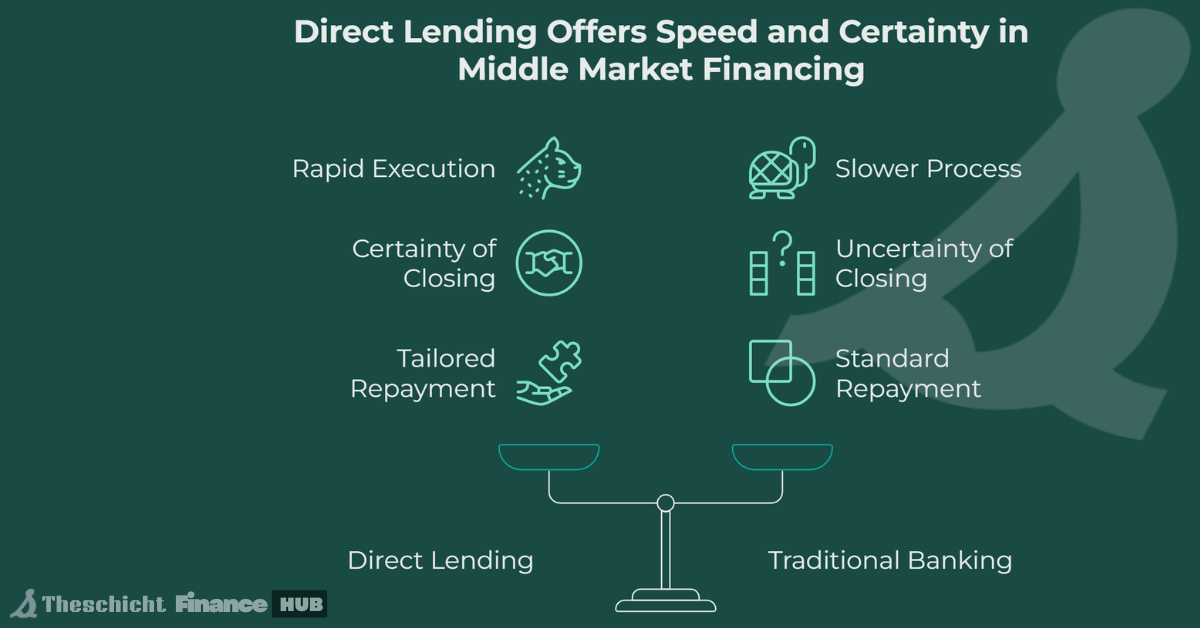
Private credit offers rapid execution and tailored repayment schedules for borrowers, and that's the whole competitive pitch. Direct lenders beat banks on speed, on certainty of closing, and on willingness to structure around a specific situation. When a private equity sponsor is racing a deadline on an acquisition, the certainty of a private lender usually wins over a cheaper but slower traditional bank lending process.
Capital Structure and Where Private Credit Fits
A company's capital structure is just the pecking order — who has a claim on the cash flows and assets, and in what sequence.
At the top: first-lien senior secured debt. Highest repayment priority, real collateral behind it, the best recovery prospects if things go badly. Senior secured loans from direct lending strategies live here.
Below that sit unitranche facilities, second-lien debt, mezzanine and subordinated debt, and preferred equity — each step down trading better recovery for higher yield.
Senior secured direct lending sits above high yield bonds, mezzanine, and equity in repayment priority. That position in the borrower's capital structure is the single biggest reason recovery prospects look better than they do for unsecured paper. Knowing where private credit assets sit in the hierarchy is knowing what you actually bought when you invest in private credit.
None of this is theoretical, either. The line between senior and subordinated debt decides who gets paid, how much, and how long they wait.
How Private Credit Managers Add Value
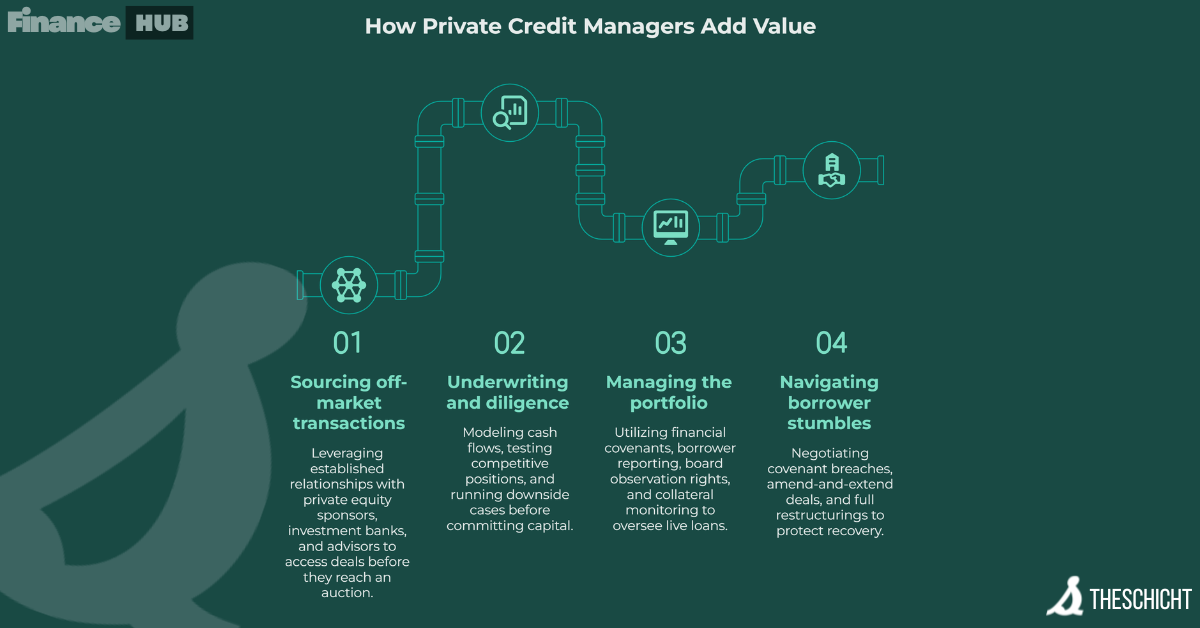
Good private credit managers are doing four jobs at once: sourcing, underwriting, structuring, and managing the portfolio after the money goes out the door.
Sourcing is a network business. Established teams have years of relationships with private equity sponsors, investment banks, and advisors, and a lot of what they see never reaches an auction. Well-connected private credit investors get first look at off-market transactions, which is worth something in a competitive market.
Then comes diligence, and this is where managers separate. They're modeling historical and projected cash flows, reading the industry structure, testing competitive position, and forming a judgment about management. The good ones run the downside case before they commit, not after.
Risk management, once the loan is live, runs on a few tools:
- Financial covenants that fire early warnings
- Regular borrower reporting
- Board observation rights
- Continuous collateral monitoring
And when a borrower does stumble, experience matters enormously — negotiating covenant breaches, amend-and-extend deals, and full restructurings to protect recovery. Manager selection is critical due to performance variability among private credit funds. The gap between top-quartile and bottom-quartile managers can be wide, and it widens most during credit cycles, when sloppy underwriting from three years earlier finally shows up.
Why Investors Consider Private Credit
Through 2026, the pitch for private credit still rests on three things: income, diversification, and returns that hold up when inflation doesn't behave.
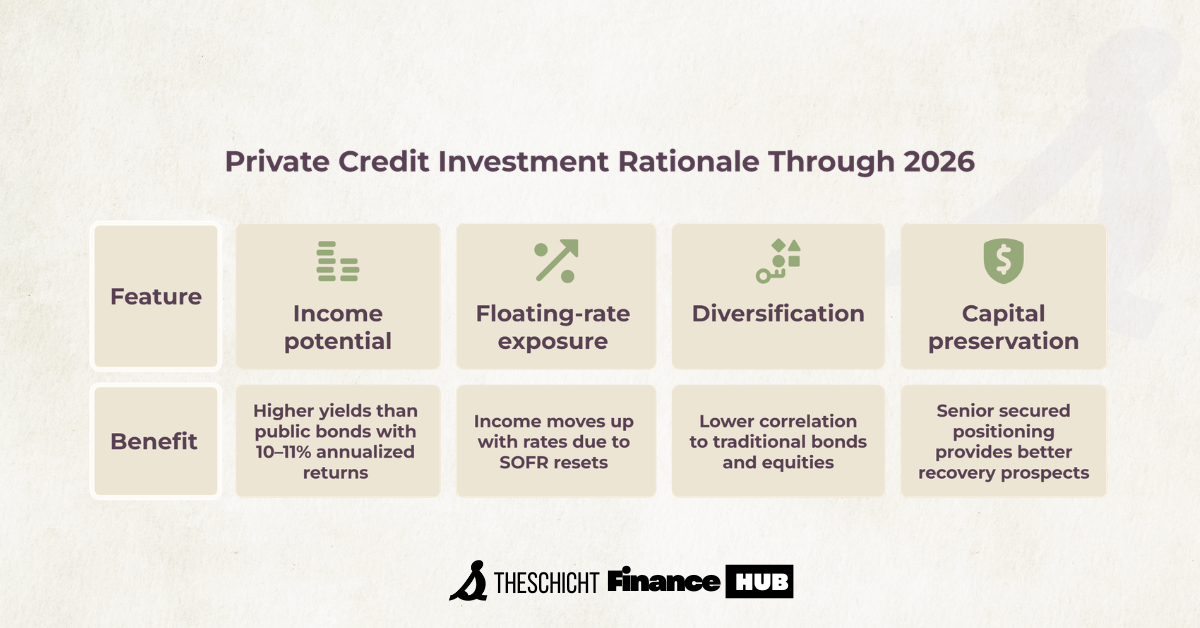
Income potential. Private credit loans typically offer higher yields than public bonds, with private credit yields historically running about 1.66 percentage points above comparable public loans. The Cliffwater Direct Lending Index returned 9.3% in calendar 2025, against a twenty-year average of 9.5% and only one negative year in that span, 2008. Interest income did the heavy lifting at 10.4%. But returns have softened since: CDLI came in at 3.0% for the first half of 2026 and 7.7% for the trailing year to June 30. Still ahead of investment-grade corporates and most mutual funds holding public fixed income — just not the double-digit number the asset class was advertising two years ago.
Floating-rate exposure. Because most loans reset over SOFR, income moves up with rates instead of getting crushed by them. With policy rates still high in 2026, those floating-rate structures have kept cash flows healthy.
Diversification. Private credit typically shows lower correlation to traditional bonds and equities. Private credit investments can enhance portfolio diversification because performance depends more on individual borrower fundamentals than on market sentiment. The caveat matters, though: correlations have a habit of converging in a genuinely severe downturn.
Capital preservation. Senior secured positioning, with collateral and covenants behind it, gives first-lien loans better recovery prospects than high yield bonds. Past performance in relatively controlled default environments supports the argument. It doesn't guarantee it.
Key Risks and Challenges of Private Credit
Nobody hands you an extra 300 basis points for free. You're being paid to hold risks that mostly stay quiet until late cycle, and then don't.
Credit risk. Borrower defaults are the central risk in private credit investments, and credit risks here are higher because borrowers carry lower credit ratings and more leverage than public issuers. Private credit loans also have lower recovery rates upon default than public loans.
What the default rate actually is depends entirely on who's counting, and the gap is enormous. Proskauer's Private Credit Default Index, which tracks senior-secured and unitranche loans, recorded 2.51% for Q2 2026 across 716 loans representing $195.6 billion — down slightly from 2.73% in Q1 2026, but well up from 1.84% in Q3 2025. Fitch, using a broader definition, reported the U.S. private credit default rate hitting a record 6.0% in April 2026. Moody's puts 2025 headline rates at 1.6% to 4.7%, and estimates that distressed restructurings — debt exchanges and maturity extensions agreed under pressure — accounted for roughly 65% of all private credit defaults that year. Strip those out and the number looks calm. Count them and it doesn't.
This is why one of the questions further down this page matters more than it looks: ask any manager how they define a default before you read their track record.
![Credit Risk — [ˈkre-dit ˈrisk] - TheSchicht](https://theschicht.com/content/images/2026/08/Credit-Risk--------kre-dit---risk----TheSchicht.png)
Credit Risk — [ˈkre-dit ˈrisk]
The chance a borrower doesn't pay you back on the terms you agreed.
In private credit it's the dominant risk, because borrowers tend to be leveraged middle market companies without public ratings. Two things determine what it costs you: how likely a default is, and what you recover afterward. Senior secured positioning improves the second. It does nothing for the first.
Illiquidity risk. Private credit is illiquid, and it often commands higher interest rates precisely because of that. There's no deep secondary market to exit into. Private credit funds often require a multi-year lock-up period for investments, so your money is committed whether or not your circumstances change.
Valuation and transparency risk. Private credit is characterized by a lack of ongoing financial reporting and lower transparency. Instead of a market price, you get a manager-determined mark. Private credit investments often involve limited transparency and reporting compared to public markets, which means you're trusting someone else's valuation model.
Structural risk. Some private credit funds add leverage at the fund level, which amplifies losses in a downturn. And when investor liquidity expectations don't match the underlying assets, redemption spikes turn into a problem quickly.
Late-cycle vulnerabilities. Interest coverage ratios have declined, indicating rising liquidity risks. Borrowers running thin coverage in a high-rate environment have very little margin for error, and refinancing risk gets worse the longer borrowing costs stay elevated.
Payment-in-kind interest is the signal worth watching, and right now it's telling two different stories. At the largest exchange-traded BDCs, PIK income fell to 8.2% of total interest income in Q1 2026, down from 8.6% in Q4 2025 and the lowest reading in two years. At non-traded BDCs it moved the other way: PIK income across the nine largest rose roughly 42% year over year in the same quarter. Loans carrying some PIK component still average around 16% of total investments at listed BDCs, and that exposure is concentrated — five funds hold about three-quarters of it. Borrowers paying interest with more debt is rarely a sign of strength, and where it's happening matters as much as how much.
Liquidity, Redemption Policies, and Access for Individuals
For most of its history, private credit was institutional territory — pensions, insurers, endowments, hedge funds. That's changed a lot.
Traditional closed-end funds still run on capital calls and drawdown structures, with 7–10 year fund lives and steep minimums. Private credit funds often require million-dollar commitments from investors, which rules out most individuals immediately.
The newer structures were built to fix that:
- Interval funds: periodic redemptions, monthly or quarterly, subject to caps
- Non-traded BDCs: less liquid, with share pricing that may not fully track underlying value
- Evergreen/private funds: more flexible than drawdowns, but notice periods still apply
Read the redemption terms carefully, because caps are the norm rather than the exception. Many semi-liquid vehicles cap withdrawals at around 5% of NAV per quarter. Go past that in a stressed quarter and you get pro-rata fulfillment, a queue, or an outright gate.
Public BDCs listed on stock exchanges are the exception — you can sell any day the market is open. What you give up is price stability. Share prices can drift a long way from underlying NAV, in either direction.
Business Development Companies (BDCs) and Public Access
Business development companies were created in the U.S. in 1980 to push private capital toward small and middle market businesses. Structurally they resemble closed-end funds: they invest mainly in private credit — direct loans, mezzanine, related strategies — and pass most of the income through as dividends.
Feature | Publicly Traded BDCs | Non-Traded / Private BDCs |
|---|---|---|
Liquidity | Daily (exchange-listed) | Limited; periodic redemptions |
Valuation | Market-driven (may diverge from NAV) | NAV-based, less transparent |
Investor access | Open to all | Often accredited only |
Volatility | Higher (market sentiment) | Lower (but less liquid) |
Business development companies BDCs have become the main route for non-institutional investors into private credit, reached through ordinary public equity markets. You get exposure to private lending and private debt investments without signing up for a multi-year lockup.
Just don't treat them as interchangeable. Some BDCs are almost entirely first-lien senior secured. Others lean into junior capital or distressed debt for yield. Before you buy, look at the track record, how concentrated the portfolio is, how much leverage sits on the balance sheet, and what the fees actually cost you.
Private Credit vs. Traditional Fixed Income
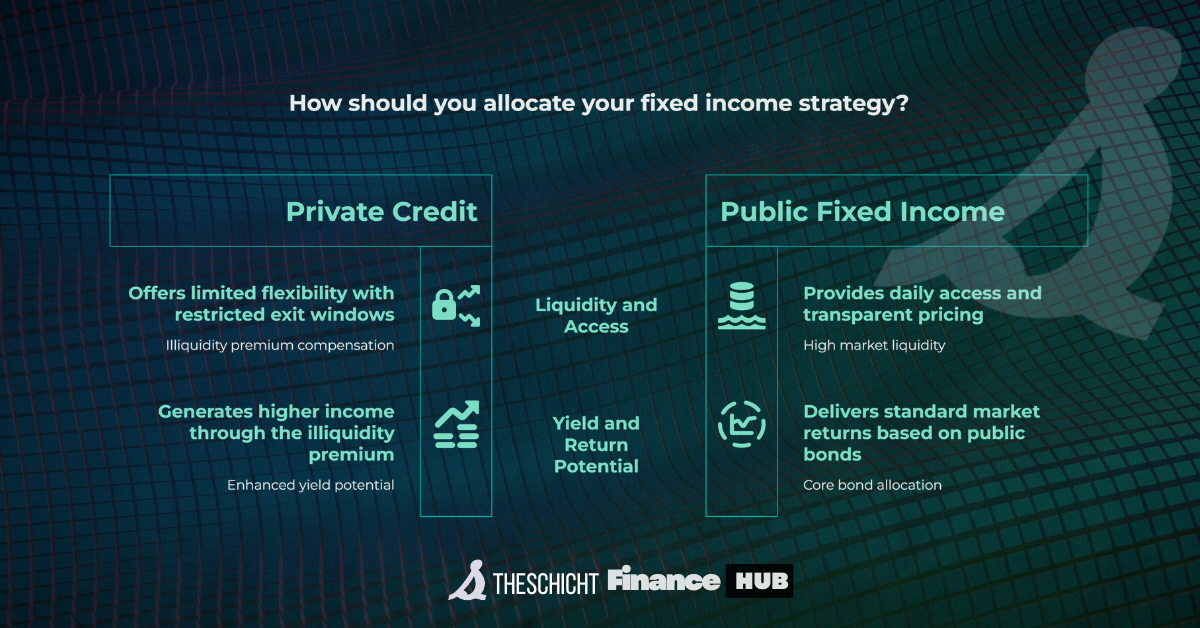
Private credit works best alongside a core bond allocation, not instead of one. Here's how private credit compared to the liquid alternatives:
Dimension | Private Credit | Investment-Grade Bonds | High Yield Bonds |
|---|---|---|---|
Rate structure | Floating (SOFR +) | Mostly fixed | Mostly fixed |
Seniority | Generally senior secured | Varies | Often unsecured |
Liquidity | Illiquid; held to maturity | Daily trading | Daily trading |
Transparency | Limited; internal valuations | Public ratings, pricing | Public ratings, pricing |
Yield | Higher | Lower | Moderate-high |
Covenants | Tighter, negotiated | Standardized | Often loose |
Private credit loans are typically less liquid than public bonds, and the extra yield is supposed to be your compensation for that. It's usually called the illiquidity premium. Whether it actually shows up in your returns depends on underwriting quality, how crowded the market is when the loan gets written, and how well the manager executes.
So when you're deciding how private credit fits your investment strategy, the questions are position size, time horizon, and how comfortable you are not knowing exactly when you can get out. Public fixed income gives you daily access and a visible price. Private debt funds give you more income and take your flexibility.
Regulation, Oversight, and Systemic Risk Considerations
A multi-trillion-dollar lending market operating largely outside banking supervision was always going to attract regulatory attention. Private credit managers are generally regulated as investment advisers or investment companies, but they don't face the capital and liquidity requirements that apply to banks — which is both why the sector moves fast and why supervisors keep writing about it.
The recurring concerns:
- Opaque loan valuations and inconsistent definitions of what counts as a default
- Leverage stacked at both the fund level and the portfolio company level
- Redemption-liquidity mismatches inside semi-liquid vehicles
The Financial Stability Board's 6 May 2026 report on private credit vulnerabilities flagged all three, plus complex interlinkages with banks and rising reliance on payment-in-kind loans as a signal of deteriorating credit conditions — and warned that a sector this size has never been tested by a prolonged downturn. The bank connection is easy to underestimate: the six largest U.S. banks now have an estimated $300 to $322 billion committed to private equity and private credit fund sponsors, against roughly $10 billion in 2013.
The following day, the OCC's Spring 2026 Semiannual Risk Perspective made private credit a discrete area of focus for the first time, citing bank exposures, concentrations, refinancing risk, and PIK structures that obscure underlying credit quality. The Fed's Financial Stability Report, out the same week, expanded its own coverage.
Most assessments as of mid-2026 still land in a similar place. The IMF's April Global Financial Stability Report found liquidity mismatches largely confined to semiliquid structures, and IMF staff called default rates around 2 to 3% manageable. The qualifier: vulnerabilities could build if growth runs unchecked or underwriting standards slip. Rules on disclosure, stress testing, and liquidity management are still being written.

How to Invest in Private Credit Thoughtfully
Start with whether this fits your goals, your horizon, and your risk tolerance — not with which fund to buy. None of what follows is investment advice; it's a framework for asking better questions.
Before committing to any private credit allocation, get answers to these:
- What's the manager's track record through more than one credit cycle?
- How concentrated is the portfolio by borrower, sector, and geography?
- How much leverage is being used — at the fund level and at the borrower level?
- What's the full fee structure, including performance fees and catch-ups?
- How does the manager define defaults, nonaccruals, and distressed exchanges?
- What are the redemption terms, gates, and caps in a bad quarter?
Diversify within the allocation, too. A core position in direct lending funds with selective exposure to mezzanine, asset-based finance, or other alternative investments beats one concentrated bet. Spreading across private credit firms also means a single manager's underwriting mistakes don't define your outcome.
Outlook for Private Credit in a Higher-Rate, Late-Cycle Environment
The backdrop heading through 2026 is awkward. Policy rates are still elevated, U.S. GDP growth has cooled to around 1.5%, and financing conditions have tightened.
The opportunity: higher base rates mean stronger coupons on floating-rate paper. New loans written at today's SOFR levels generate real income, and managers with genuine underwriting discipline can pick up good assets as weaker competitors retreat.
The risk: borrowers already running thin interest coverage are under pressure, and the stress is in the data, not the forecasts. Fitch's measure of the U.S. private credit default rate hit a record 6.0% in April 2026. Volume is cooling too — BofA Global Research expects private credit loan issuance to fall around 15% to $120 billion in 2026, with sponsor-backed direct lending volume already running 23% below the prior year's pace.
Meanwhile large private credit platforms compete harder with each other and banks re-enter some leveraged lending niches, which compresses spreads and loosens covenants — usually in that order.
So expect dispersion to widen. Strong underwriters should hold up; weaker platforms will eat credit losses and face redemption pressure at once. Treat private credit as a long-term allocation you monitor actively, not a tactical trade on where rates go next.
Frequently Asked Questions
How does private credit differ from high yield bonds in practice?
High yield bonds are publicly issued, broadly syndicated, and marked to market daily on a secondary exchange. Private credit loans are privately negotiated, held to maturity, and valued internally rather than by a market. Private credit usually brings tighter covenants, senior secured positions, and floating rates; high yield bonds are more often unsecured and fixed-rate. The practical gap is liquidity: you can sell a high yield bond today at a visible price, but exiting a private credit loan means finding a buyer in a thin secondary market.
Who are the typical borrowers in private credit deals?
Mostly middle market companies with stable or growing cash flows, concentrated in healthcare, software, manufacturing, and business services. A large share are sponsor-backed businesses owned by private equity firms pursuing buy-and-build strategies, recapitalizations, or leveraged buyouts. In specialty finance and asset-based strategies, the borrower may be a pool of consumer loans, equipment leases, or real assets rather than a single company.
Is private credit appropriate for individual investors seeking liquidity?
Generally no — not as your source of liquidity. It suits multi-year horizons where you won't need the capital back quickly. Publicly traded BDCs offer daily tradability through stock exchanges, but prices swing with sentiment. Interval funds and non-traded BDCs open limited monthly or quarterly redemption windows, usually capped. If you need near-term access or an emergency reserve, cash, money market instruments, and liquid fixed income come first.
How do rising or falling interest rates affect private credit returns?
Floating-rate structures push income up when benchmark rates rise, since coupons reset higher over SOFR. When rates fall, coupon income drops — though borrower health and default risk usually improve, offsetting part of the hit. Many private credit loans carry base-rate floors that preserve a minimum level of interest income even when benchmarks fall sharply. The interaction between rate moves, borrower health, and debt financing costs is more layered than "rates up equals better."
What role can private credit play in a diversified portfolio?
A satellite role, around a core of liquid fixed income and equities — an income engine whose return drivers differ from public markets. Size it to your risk tolerance. A conservative investor might cap private credit at 5–10% of total assets, split across direct lending strategies, mezzanine, and asset-based approaches rather than concentrated in one fund or one manager.
- Financial Stability Board, Report on Vulnerabilities in Private Credit (6 May 2026)
- OCC, Semiannual Risk Perspective, Spring 2026
- IMF, Global Financial Stability Report, April 2026
- Bureau of Economic Analysis, Gross Domestic Product
- Proskauer Private Credit Default Index, Q2 2026
- Cliffwater Direct Lending Index, 2025 results
- Cliffwater Direct Lending Index, H1 2026
- PitchBook LCD, May 2026 US Private Credit Monitor
- PitchBook LCD, PIK interest income at BDCs falls for third straight quarter
- Cleary Gottlieb, Outlook for Private Credit in 2026
- Wellington Management, What investors should watch as private credit matures
- With Intelligence, Private Credit Outlook 2026
- Forbes, Rising Private Credit Defaults Are Testing Banks And Insurers

Back TheSchicht and help fund independent financial research.
See you in the next one.
Founder & Editor, TheSchicht
Independent financial research and analysis.